Flet 0.84.0: Goodbye MkDocs, hello CrocoDocs!

Flet 0.84.0 is a developer-experience release: new documentation website and re-worked examples.
Highlights in this release:
- Flet docs are back on Docusaurus - fast dev server, working hot reload, unified website.
- Meet CrocoDocs, our new tool that bridges Python docstrings and Docusaurus.
- All 466 Flet examples migrated to standalone projects with rich metadata for Gallery and AI discovery.
How to upgrade
If you use pip:
pip install 'flet[all]' --upgrade
If you use uv with pyproject.toml and want to upgrade everything:
uv sync --upgrade
If you want to upgrade only Flet packages:
uv sync --upgrade-package flet \
  --upgrade-package flet-cli \
  --upgrade-package flet-desktop \
  --upgrade-package flet-web
Goodbye, MkDocs! Hello, CrocoDocs!
The Flet website has always been built on Docusaurus - it's fast, extensible, and has great MDX support. But we were authoring API docs manually, which caused synchronization issues with the source code and a lot of duplication: we'd write the same content in Python docstrings and then again in Docusaurus pages.
For Flet "v1", @ndonkoHenri made a huge push by moving all API docs into Python docstrings and configuring MkDocs + Material for MkDocs + mkdocstrings to serve Flet documentation. It was a great and timely decision to make docstrings the single source of truth.
And it worked, but with some quirks:
- Flet has a large codebase with many cross-references. The docs dev server took around 3 minutes to start.
- For some reason, hot reload was not working - which meant making a change, restarting, and waiting another 3 minutes to see the result!
Then, one day, we saw this warning in a build log and got a feeling that something was off:
WARNING - MkDocs 2.0 is incompatible with Material for MkDocs
Apparently, there is a whole story that has been developing for a few years. The short version: the MkDocs original author started working on MkDocs 2.0 which drops plugin support and is not compatible with MkDocs 1.x. The Material for MkDocs team started working on Zensical, a MkDocs rewrite in Rust that is backward-compatible but launched with many plugins still missing.
We decided to bring docs back to Docusaurus - but this time with a tool that keeps docstrings as the single source of truth.
Meet CrocoDocs

CrocoDocs is our home-grown tool that transforms Flet API data into a form that Docusaurus can render. The idea is simple: extract API information from Python docstrings using Griffe, produce JSON data and MDX partials, and let Docusaurus render everything using custom MDX components and remark plugins.
The pipeline looks like this:
- Extract - Griffe parses all Python packages and collects classes, functions, docstrings, and type annotations.
- Transform - CrocoDocs builds an
api-data.jsonwith all API entries and a cross-reference map (xref_map) that resolves symbol names to documentation URLs. - Generate - MDX partials are produced for CLI docs, permissions, and the PyPI package index. Code examples are indexed from the examples directory.
- Render - Docusaurus picks up the generated data and a custom remark plugin resolves cross-references into clickable links.
It's a modern Python project, managed with uv and configured entirely via pyproject.toml.
New cross-reference format
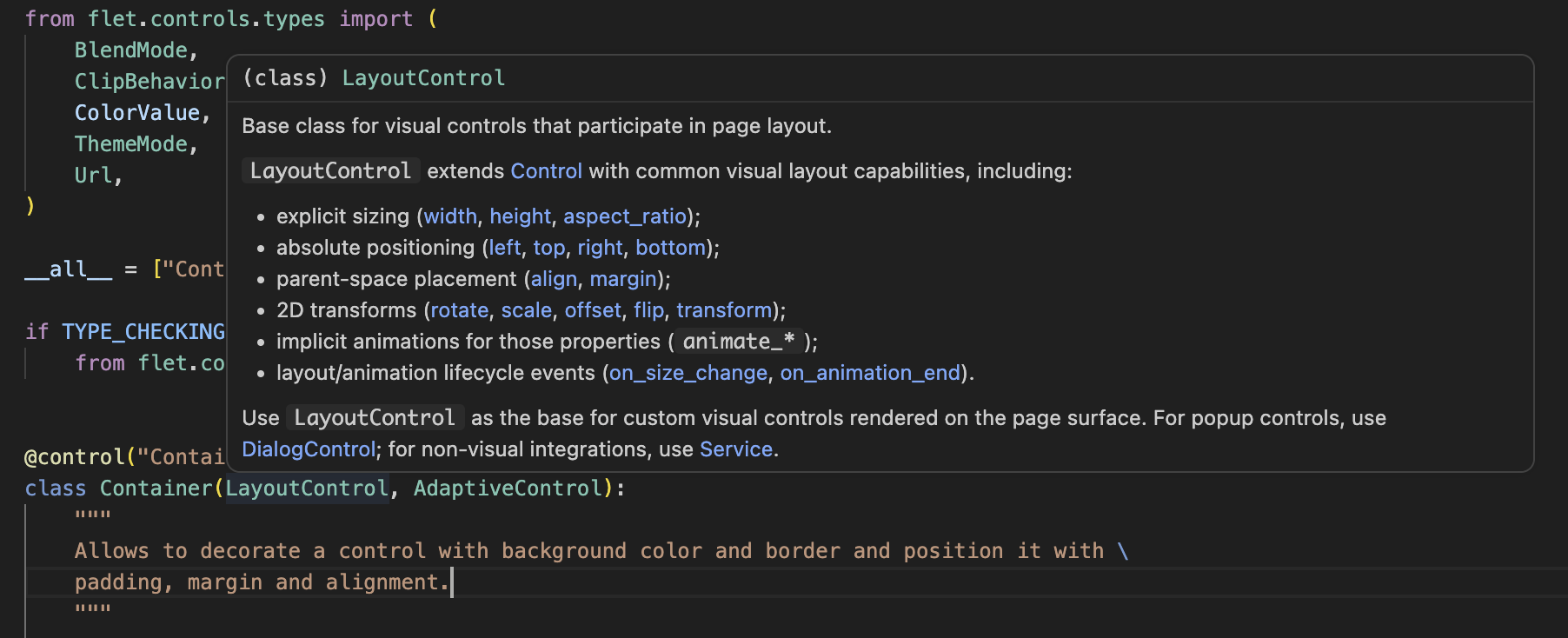
We switched from mkdocstrings-python-xref format to reST-style roles in docstrings. This was a deliberate choice: reST roles are a well-known standard, and - crucially - they are navigable in VS Code and other editors that render docstring tooltips.
Before (mkdocstrings):
"""See [Page][flet.] and [Control.visible][flet.] for details."""
After (reST roles):
"""See :class:`~flet.Page` and :attr:`flet.Control.visible` for details."""
The supported roles are :class:, :attr:, :meth:, :func:, :mod:, :data:, and :obj:. The ~ prefix shortens the display name - :class:~flet.Page`` renders as just "Page" while still linking to the full path.
Here's what it looks like in VS Code - docstring links are rendered and navigable right in the tooltip:
Strict CI checks
In addition to the broken-link checks that Docusaurus performs during build, we added a custom CI script with strict validation:
- Broken images - verifies that every
<img src="...">points to an existing file. - Unresolved reST xrefs - catches any
:class:,:attr:,:meth:markers that were not resolved to links. - Missing code examples - flags
<CodeExample>components that reference non-existent example files. - Missing API entries - detects symbols referenced in docs but absent from
api-data.json.
If any check fails, the build fails. No broken docs make it to production.
The results
The migration from MkDocs to Docusaurus brought exactly what we hoped for:
- The generate phase and Docusaurus dev server start in a few seconds (down from ~3 minutes).
- Hot reload works. Change a page, save, see the update.
- A single unified website for the landing page and docs, with a modern design.
- Full-text search with Algolia.
- A tool we own and can evolve as Flet grows.
CrocoDocs is not yet available on PyPI, but if you'd like to adopt it for your Python project - let me know!
More info:
- PR: #6359
Examples migrated to projects
Every Flet example is now a standalone project with its own pyproject.toml and rich metadata. Here's why we made this change:
Better discovery. Each project carries structured metadata - categories, description, keywords, a list of controls used, complexity level, and more. We need this data for building Gallery v2 (available on the website and as a Flet app) and for building the index for Flet MCP, so AI assistants can find the right example for you.
Easier to build and run. Previously, if you wanted to try an example, you'd copy it into your own project, figure out the dependencies, and wire things up. Now every example is a complete project you can clone and run directly with flet run.
Self-contained. Every project includes all its dependencies (flet_charts, flet_map, etc.), permissions, bundle IDs, and assets needed to successfully build and run on any platform.
What a project looks like
Before - a flat Python file with no metadata:
sdk/python/examples/controls/
├── button_examples.py
├── canvas_examples.py
└── ...
After - a structured project directory:
sdk/python/examples/controls/
├── material/
│   └── button/
│       ├── basic/
│       │   ├── main.py
│       │   └── pyproject.toml
│       ├── icons/
│       │   ├── main.py
│       │   └── pyproject.toml
│       └── styling/
│           ├── main.py
│           └── pyproject.toml
├── core/
│   └── canvas/
│       ├── bezier_curves/
│       ├── brush/
│       └── ...
└── cupertino/
    └── cupertino_button/
        └── basic/
Each pyproject.toml includes Gallery and MCP metadata:
[project]
name = "button-basic"
version = "1.0.0"
description = "Basic enabled and disabled Button examples."
keywords = ["button", "material", "basic", "disabled"]
dependencies = ["flet"]

[tool.flet.gallery]
categories = ["Buttons/Button"]

[tool.flet.metadata]
title = "Basic button"
controls = ["SafeArea", "Column", "Button"]
layout_pattern = "inline-actions"
complexity = "basic"
features = ["enabled and disabled states"]
In total, 466 examples were migrated to this format.
More info:
- PR: #6355
Conclusion
Flet 0.84.0 is about the ecosystem around the framework: better docs, better examples, better tooling. CrocoDocs gives us a documentation pipeline we can trust and evolve. Standalone example projects make every sample discoverable, runnable, and ready for AI-assisted workflows.
Try it and share feedback in GitHub Discussions or on Discord.
Happy Flet-ing!